“If you can’t explain it simply, you don’t understand it well enough.”
–Albert Einstein
THE SECRET OF CHAPMAN’S VELO
Drive Your Stride
I’m certainly not going to argue with Albert. So I’m offering a simple chunk of science to explain why Aroldis Chapman throws bullets.
I like pitchers to increase their stride length aggressively without straining. It has to be natural. It has to feel right. Linear energy goes hand in hand with rotation. It’s pure physics. Just ask Einstein. The stronger you drive down the hill, the harder you’ll throw.
This is not “reaching out” with your leg. It’s not jumping to the plate. It really has little to do with your stride leg at all. It’s about the initial drive you get from your backside as you ride your glutes, quad, hip and knee. They supply the power. Everything starts from the beginning.
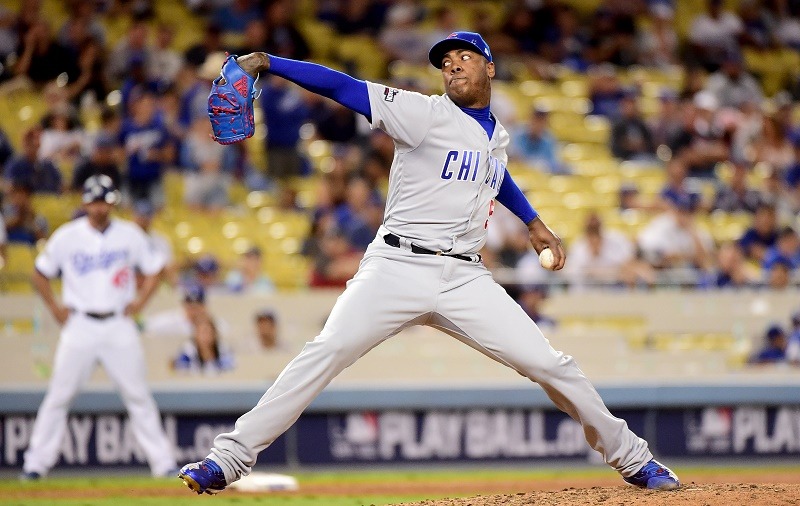
Chapman floors it down the hill. This is also classic hip and shoulder separation, which we’ll dissect later.‘
Nolan Ryan at 108.6 clicks
The Sports Science guys tell me the “average” pitcher only strides 87% of his height. Chapman’s stride is 7.5 feet long. That’s 120%. And the “average” guy releases the ball above his front foot. Chapman’s release is as much as 12 inches farther out.
Chapman blitzed a 105.1 spear that was still buzzing like a tornado when it hit the glove. The defense rests. I could search for a decade and never find better proof than that. There are gurus who think velo is all rotation. But I think Drive and Rotate go together like water and the backstroke, like Brady and Bellichick. Okay, that was yesterday.
Fire your glutes and back leg. Ride them down the hill. Extend your stride. Don’t strain. But get out there. Boy, that was easy, Albert.
*********************************************************** Radar Guns—a gift from Heaven or demon from Hell?
In 1973 Michigan State coach Danny Litwhiler bought a radar gun from the local police and asked the Jugs company to convert it into a tool to measure pitching velocity. And it changed the game like Bill Gates overhauling technology. Baseball was hooked for better or for worse.
Radar guns dominate scouting, TV, and the future of thousands of prospects. They are Zeus, Valhalla, the End of the Rainbow. But they are only a snapshot, a guide, a nudge in the right direction.
A serious scout adds movement, late life and deception to the mix. And no radar gun can measure the craft, the intelligence, the competitive passion of a Kyle Hendricks or Zack Greinke, two of the most successful pitchers currently on the hill. When they throw the radar gun breaks out in laughter.
/cdn.vox-cdn.com/uploads/chorus_image/image/47582213/usa-today-8862899.0.jpg)
How do you gun Greinke’s finesse and guts?
And there’s also one key factor. Where do you measure fastball velo?
In the early days there were two brands of radar. The Jugs Gun reading was right out of the hand, about 10 feet after release. The Ray Gun number was when the ball crossed the plate.
The drop off was anywhere from 4 to 8 miles per hour, And that was significant to scouts who knew it measured life, carry, real arm strength. The less drop off the better.
These days the Stalker Gun is king. And the readings are always out of the hand because that’s more impressive on the scoreboard or TV screen. So be it.
***********************************************************
By the way, Nolan Ryan was gunned at 108.6 at release. And Bob “Rapid Robert” Feller clicked 107.6 on some sort of dubious photo electric machine.
Hicks and the power of drive
Before he tore his UCL Jordan Hicks blitzed the gun at 102 plus as often as Parisians drink red wine. And he peaked at 104. Take a good look at this pic, which tells a story as lucidly as a National Geographic doc.

His stride is aggressive and straight down the line. All that drive emanates from his back hip and knee, his glutes and quads, and his stable post foot. What’s more, Jordan’s hips are just starting to open while his shoulders stay closed.
Throwing 102 is not an accident. It’s not a roll of the dice. It’s all summed up by these perfect mechanics.
Lots more later when we examine why Hicks throws so hard.
Follow My Blog
Get new content delivered directly to your inbox.
 Dave Talks Baseball